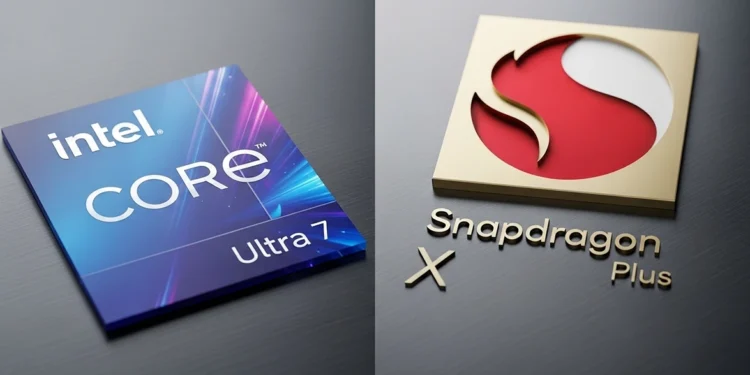
The moment a laptop stops dying before the meeting ends, the person carrying it stops caring about clock speeds. Battery anxiety is a real productivity tax that millions of professionals pay every single day. As Snapdragon challenges Intel processors for laptop dominance, the processor inside that machine is the primary reason the charger never leaves the bag. For years, Intel offered only a thicker chassis and a longer power brick, because there was simply no serious competition forcing a better solution onto the market. Any professional who has watched a battery indicator drop below ten percent during a client presentation knows exactly what is at stake when the wrong processor ends up inside an expensive machine.
That changed the moment Qualcomm’s Snapdragon processor line proved that a full Windows machine could survive an entire workday without ever touching a wall outlet. The processor battery life tradeoff between these two architectures is now the most consequential hardware decision a professional buyer faces. The wrong choice based on incomplete information leads directly to frustration, wasted budget, and a machine that fails the job it was purchased to perform. Neither architecture is universally superior. Each one wins decisively in the specific conditions it was engineered to serve, and understanding those conditions before the purchase is made is the only way to avoid an expensive lesson in hindsight.
Snapdragon Challenges Intel Architecture
Qualcomm did not enter the PC processor market by competing on Intel’s terms. That decision makes Snapdragon a genuine disruption rather than a marketing exercise. The engineering team imported its power management discipline from the mobile processor space. That discipline allows smartphones to run demanding applications all day on relatively small batteries. Windows professionals have historically expected to plug in every four to six hours. Qualcomm applied the same discipline to overturn that expectation. The result is a processor that manages heat and power at the silicon level, reducing its dependence on active cooling.
Intel Responds to the Snapdragon Threat
Intel’s response to this competitive pressure is visible in every architectural decision inside the Core Ultra 7 265K. The urgency behind those decisions reflects a company that saw the threat before the broader market did. Removing hyper threading was not a minor refinement. It was a direct admission that the power overhead was no longer acceptable. At the same time, a mobile chip manufacturer was demonstrating silent, sustained operation under real professional workloads without a cooling fan anywhere in the chassis. Intel publishes the specifications behind this architectural shift at the Intel Core Ultra 7 documentation page for engineers who need to validate power delivery requirements before committing to a fleet deployment decision.
Snapdragon Transforms the Platform Choice
This competition is driving measurable improvements in technology on both sides. It rewards professional buyers through better performance and more competitive pricing. What began as a niche ARM based Windows experiment has matured into a legitimate platform choice. It now demands careful evaluation. That evaluation must reflect the specific demands of the real workloads it will serve. The processor and battery life tradeoff is no longer about benchmark endurance. It is now about which architecture fits a professional’s actual working day.
ARM Processors Rewriting x86 Workloads
Snapdragon Thermal Performance Under Sustained Use
A full day of video calls, spreadsheet work, and document editing keeps the Surface Pro 11 cool to the touch. The cooling fan never engages. The Snapdragon X Plus spreads workload intensity across ten performance cores. Each core runs inside a tight power envelope that prevents sustained heat buildup. In a three hour video conference with screen sharing and background browser tabs, the chassis temperature stays comfortable on a lap or desk. Qualcomm explains this thermal behavior in the Snapdragon X Series documentation for buyers who want to review the engineering decisions before choosing the platform.
The Lenovo Yoga 7i running the Core Ultra 7 265K tells a measurably different thermal story during the same workload conditions. The difference becomes audible within the first twenty minutes of sustained use. The cooling fan engages as the processor scales to meet the demand of active video encoding, real time collaboration, and background application management simultaneously.
It produces an audible hum that becomes a permanent background companion during intensive sessions. This is the physical consequence of moving twenty cores through an instruction set never architected with fanless operation as a primary constraint. The thermal management system compensates for this overhead effectively. During a quiet boardroom presentation or a focused client call, it surfaces at precisely the moment that silence matters most.
Intel Battery Endurance Outlasted by Snapdragon
A five hour cross country flight with the Surface Pro 11 used about 35 percent of total battery capacity while running document editing, offline email drafting, and periodic cached web browsing. That result places a full charge well beyond most domestic travel itineraries. It also keeps the charger in the carry on bag. This outcome reframes how Snapdragon challenges Intel processors from abstract specifications into a tangible daily experience. That experience changes how a professional packs for a business trip. The full field performance data appears in the Surface Pro 11 field assessment, where the team records thermal and consumption measurements against actual working conditions rather than synthetic benchmarks.
It reframes how Snapdragon challenges Intel processors from an abstract specification into a tangible daily experience. That experience changes how a professional packs for a business trip. The full field performance data is available inside the Surface Pro 11 field assessment. The team records thermal and consumption measurements against actual working conditions rather than synthetic benchmarks.
Snapdragon Redefines Portable Endurance
The Lenovo Yoga 7i completed the same five hour scenario at roughly 60 percent battery consumption. That still delivers a genuine full workday of productivity on a single charge. It is a meaningful improvement over the previous Intel generation under similar real world conditions. The distinction is not that the Intel machine fails under travel pressure. The Snapdragon system instead redefines portable endurance for professionals who measure productivity away from a fixed desk. The Lenovo Yoga desktop analysis examines the engineering decisions behind the 16 inch form factor in detail.
The Lenovo Yoga desktop analysis analysis examines the engineering decisions behind the 16 inch form factor in detail.
For professionals spending more than eight days monthly in transit, the battery endurance gap translates into fewer power adapter searches. That reduction sounds minor in isolation. Accumulated across a full quarter of active travel it represents hours of recovered productivity. It also reduces the low grade anxiety that accompanies watching a battery indicator approach critical levels during a meeting that shows no sign of ending on schedule.
Snapdragon Software Compatibility Challenging Intel
Snapdragon ARM Translation Layer Challenging Intel Native
The Snapdragon X Plus runs Windows on an ARM native architecture. Every application written for Intel’s x86 instruction set passes through Microsoft’s Prism translation layer before it executes on the hardware. The resulting experience depends on whether the application follows modern development standards or relies on legacy system calls. Those older calls are handled less effectively by the translation layer.
For mainstream productivity software, including office suites, cloud platforms, and modern web browsers, this translation remains invisible under normal workloads. The performance penalty is negligible during typical professional use for most knowledge workers. The compatibility problem appears with legacy professional tools, specialized audio plugins, older engineering environments, and enterprise platforms that predate the ARM transition by more than five years.
A professional whose daily workflow depends on industry software released before 2018 faces a genuine compatibility risk. No battery chart or thermal measurement reveals that risk before purchase. It also rarely appears during a standard two week return window when the workload consists of browser based tasks and modern applications. Qualcomm and Microsoft have closed much of the gap through focused compatibility work, but Snapdragon devices still challenge Intel processors on this front.
Every professional application requires verification against the current ARM compatibility database before a Snapdragon device enters production. Discovering an incompatible mission critical tool three weeks after the return window closes is an expensive and avoidable outcome.
Intel Native Compatibility Advantage
The Core Ultra 7 265K carries three decades of software compatibility without a translation layer, a compatibility footnote, or a database verification step. Every professional tool, legacy platform, specialized plugin, and enterprise system written for Windows executes natively without modification or emulation overhead.
For a small business refreshing an entire office floor of workstations, that native compatibility guarantee removes weeks of pre deployment validation work. Microsoft documents the fanless thermal design constraints that define the competing ARM platform on the Microsoft Surface Pro 11 page for buyers who want to examine both sides before making a final hardware decision.
Snapdragon Pricing Challenging Intel Strategy
The Surface Pro 11 price reflects the investment required to deliver fanless operation, multi day battery life, and a thin form factor. That premium appears immediately at the point of purchase. Buyers who compare it to a traditional laptop often overlook the productivity value of never searching for a power outlet.
As Snapdragon challenges Intel processors on price, the premium paid at purchase carries a clear cost on both sides. For professionals who spend much of their working time in departure terminals and client offices, the Snapdragon premium is often recovered in the first quarter of active travel. Not a single minute is wasted hunting for an available outlet in an airport terminal during a layover.