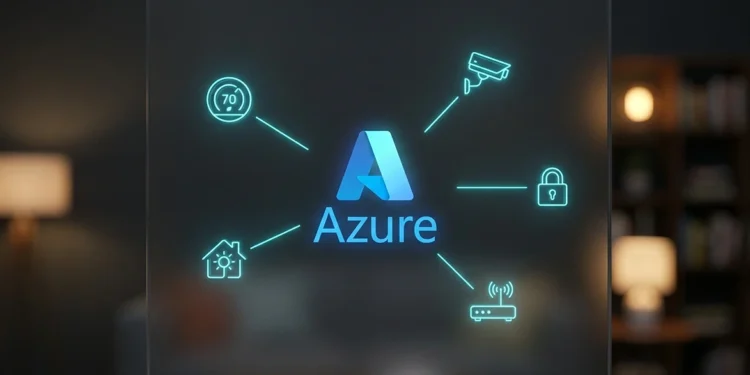
Managing a “smart” home used to mean juggling a pile of apps, each one controlled by a different big-box brand instead of you. Your thermostat reported to one platform. Your security cameras dumped footage into some other vendor’s storage, with zero say over how long they kept it or when they’d change the rules. Smart locks, lighting, automation routines — all locked into separate ecosystems, separate subscriptions, all subject to change without warning. You owned the hardware. You controlled none of the infrastructure that made it actually work. That’s the gap Azure home automation control is built to close.
Azure IoT Hub flips that script, and it does it in a way no consumer platform really can, because it treats you like an operator, not a customer. Microsoft built this thing to run millions of connected devices across global operations, where downtime or lost data actually costs something real. Bring that same infrastructure home, and suddenly your thermostat, cameras, locks, and sensors are reporting to a system that you control and not some vendor’s cloud you’re just borrowing space in. There’s no middleman deciding what features you get to keep or what disappears in the next pricing update. No subscription tier quietly limiting how much history your camera footage retains.
If you’ve ever felt like your home automation devices were really just a rental you happened to pay for outright, an Azure-based setup might be the solution that gives you more control. This alternative approach allows you to self manage your devices and offers you permanent, actual ownership over how you run your smart devices eliminating the service rental traps that lock you into recurring annual charges.
Why Consumer Platforms Fail Homeowners
Every mainstream smart home platform shipped with architecture designed for corporate priorities, not homeowner control. Devices connect to manufacturer controlled cloud servers. Homeowners never directly operate or meaningfully configure those servers. Data from sensors, cameras, and thermostats moves through corporate infrastructure before reaching the homeowner’s phone. That pattern was intentional rather than a technical compromise imposed by early hardware constraints. Manufacturers chose a design that converted device ownership into long-term platform dependency for every buyer. That decision put vendors permanently inside the home, shaping features, retention, and access without homeowner authority.
Google Home, Amazon Alexa, and SmartThings sell themselves as separate ecosystems while sharing the same dependency structure. Each platform pulls devices into its own cloud environment and ties advanced features to recurring subscriptions. A homeowner who builds automation routines inside Google Home never truly owns that logic in practice. Those routines cannot move cleanly onto independent infrastructure the homeowner controls for long-term use. Security footage stored through an Alexa-connected camera lives on storage the corporation ultimately governs. Every piece of automation logic, history, and recording sits on infrastructure the vendor controls. That dependency pattern is explored in detail at the subscription trap for anyone ready to build an alternative infrastructure.
Canceling a Subscription Exposes the True Ownership Gap
Canceling any one of those platform subscriptions reveals how shallow the ownership relationship actually was. Automation routines stop executing the moment billing lapses. Device history vanishes permanently with no recovery path. Every frame of camera footage paid for becomes inaccessible immediately. Smart locks revert to manual operation because cloud logic requires a funded account to function. Years invested building a connected home ultimately reveals the infrastructure was never yours to keep. That realization drives technically capable people toward privately owned infrastructure that never changes behavior based on billing status.
Azure Home Automation Control
Azure IoT Hub manages bidirectional communication between connected devices and a central platform. Microsoft built it to handle millions of devices across global operations, from factories and logistics networks to global device fleets. That same capability scales down to a residential context, where every thermostat, camera, lock, and sensor reports to one privately owned cloud instance instead of a collection of manufacturer controlled platforms. Deploying Azure IoT Hub as the home automation backbone delivers direct ownership of the full data pipeline with no corporate intermediary anywhere in that chain.
The pricing model distinguishes Azure from every consumer smart home platform it replaces. Azure IoT Hub runs on a consumption based model with no fixed monthly billing. Homeowners pay only for the messages their devices send and receive. No subscription continues charging regardless of actual usage levels. A typical connected home costs significantly less than combined native platform subscriptions. That cost structure scales with actual usage rather than a manufacturer’s revenue targets. Privately owned infrastructure keeps costs tied to real consumption instead of corporate pricing decisions. Full pricing details and tier comparisons are available through the Azure IoT Hub overview before committing.
Device Twins Under Your Control
Device Twins inside Azure IoT Hub give a digital representation of every connected device in the home. Each twin holds current state, desired configuration, and reported properties in a single location that updates in real time without requiring the device to be online continuously. That capability mirrors what enterprise operations teams use to manage device fleets across multiple locations and delivers the same visibility to a homeowner managing a single residence. Azure home automation control delivers real time visibility into every thermostat, lock, and sensor from a single privately owned interface. Accessing that visibility requires no manufacturer apps and no premium tier payments.
Self Hosted Home Automation Stack
Home Assistant serves as the local device communication layer sitting between the physical hardware in the home and Azure IoT Hub in the cloud. Installed on a dedicated local processor, it gives every connected device a single point of contact that speaks native protocols including Zigbee, Z-Wave, Matter, and Thread. Device commands process locally, automation routines execute without internet dependency, and device data pushes into Azure IoT Hub through a direct connection the homeowner configures and controls. Those who already built a local dashboard will find Azure extends that setup into a privately owned cloud layer. No existing local infrastructure gets replaced in the process. The complete local foundation build is covered in detail at repurpose your home hardware before the Azure layer connects to it.
Node RED Automation Flows
Node-RED sits between Home Assistant and Azure IoT Hub as the visual automation logic layer. It translates device events into actionable workflows without requiring anyone to write code from scratch. A motion sensor detecting activity at the front door triggers a Node-RED flow simultaneously. That flow locks the back door, adjusts the thermostat, illuminates the pathway, and logs the event to Azure. All of it moves through a drag and drop visual interface rather than a subscription dependent platform charging for the same capability. That visual logic layer makes privately owned home automation control accessible to technically capable people. No professional cloud development background is required to configure infrastructure you own and operate independently.
Grafana connects to Azure data storage and transforms every home data point into a centralized visual dashboard. It displays device states, automation histories, energy consumption, security camera activity, and system health in one place. The homeowner controls that interface completely. That dashboard is what consumer platforms promised but never delivered. Delivering it would have required giving homeowners full visibility into their own data. Running Grafana against Azure hosted data means the homeowner sees everything in real time. All of it stores permanently on infrastructure they own. No subscription determines how far back the history goes or how many devices appear simultaneously.
Azure Home Control Costs
The financial case for Azure home automation control becomes clear when monthly subscription costs across every replaced platform get added together honestly. Ring cloud storage, Nest Aware thermostat features, SmartThings advanced automation, and a separate VPN subscription combine into a recurring figure that compounds indefinitely without ever purchasing ownership of the infrastructure those payments fund. Azure IoT Hub on a consumption based model costs a fraction of that combined monthly total, and every dollar builds capacity on infrastructure the homeowner owns outright. Homeowners who have already eliminated the ISP rental fee will find the Azure cost sits comfortably within the budget that decision freed up. Ditch the ISP rental covers exactly what that network layer delivers before Azure connects to it.
Every connected home running on consumer platforms carries a hidden exit cost that only becomes visible when the homeowner tries to leave. Proprietary platforms lock automation routines inside their own infrastructure with no export path to a competing system. Device history sitting on a manufacturer’s cloud goes nowhere — the homeowner cannot move it to a privately owned database The corporation owned that data from the moment the homeowner generated it. Azure eliminates that exit cost entirely because the homeowner owns the infrastructure, the data, and the automation logic from the first day of deployment. The Home Assistant Azure setup documents exactly how that integration connects local device management to privately owned cloud infrastructure without routing anything through a corporate server.