The morning a Ring doorbell stopped recognizing its own network after a routine firmware push was the moment the illusion cracked. After nearly a year running this exact hardware combination across a real home environment, three hours of troubleshooting a device that cost nearly two hundred dollars revealed a fundamental design flaw that no marketing brochure mentions. The hardware was fine. The problem lived on a server owned by a company with no obligation to fix it before the weekend. That single failure exposed the fragile architecture hiding behind every glossy smart home hub sold at retail today.
Smart home gadgets arrive promising unified convenience but consistently deliver a fragmented pile of hardware that refuses to communicate without a corporate middleman. The Honeywell Total Connect app manages the thermostat while Ring owns the doorbell feed and the Onkyo receiver answers to a completely separate ecosystem with no native bridge between any of them. Consumers purchase these devices believing they are building a cohesive home system when they are actually assembling a collection of isolated subscriptions dressed up as automation.
The Corporate Promise Behind Every Smart Hub Purchase
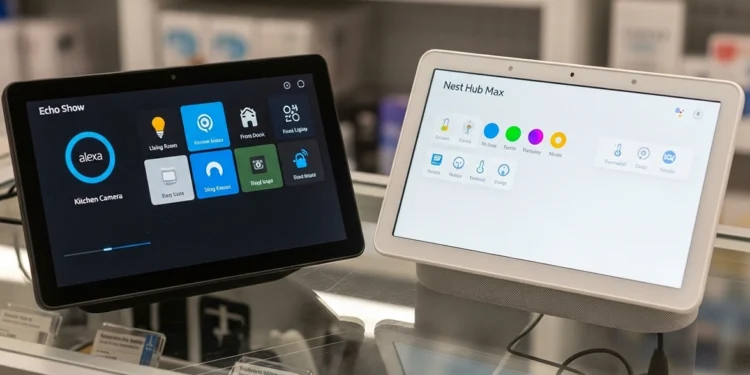
Silicon Valley spent a decade conditioning consumers to believe that a single branded screen could resolve the chaos of managing twenty disconnected devices through twenty disconnected applications. Google positioned the Nest Hub Max as the central intelligence layer for the modern home while Amazon marketed the Echo Show as the conversational command center that ties everything together. Both promises share the same fundamental flaw — the intelligence they advertise does not live in your home. It lives on a server you do not own, cannot access, and have no control over when corporate priorities shift.
The Google Nest Hub Max arrives at three hundred dollars presenting itself as a premium display with ambient sensing and face recognition built directly into the hardware. What the packaging omits is that the face matching feature requires a persistent connection to Google’s cloud infrastructure to deliver the personalization it advertises. Removing that cloud connection does not simply reduce functionality — it dismantles the core premise of the device entirely and leaves a three hundred dollar digital frame sitting on your kitchen counter.
Smart Home Cloud Dependency and the Risks You Ignore
Every major smart home ecosystem carries a subscription layer that surfaces gradually after the initial purchase. After six months running the Honeywell Total Connect Comfort platform personally, the subscription creep becomes impossible to ignore. Advanced scheduling features that existed in earlier versions of the hardware quietly disappeared behind a new service tier that was not part of the original purchase agreement. Ring’s professional monitoring adds a recurring monthly charge before doorbell camera footage becomes searchable beyond a twenty four hour window. These costs arrive incrementally which makes them easy to dismiss individually while collectively representing a permanent tax on hardware the consumer believed they owned outright.
After six months running the Honeywell Total Connect Comfort platform personally, the subscription creep becomes impossible to ignore. Advanced scheduling features that existed in earlier versions of the hardware quietly disappeared behind a new service tier that was not part of the original purchase agreement. The dependency runs deeper than subscription fees because the cloud infrastructure itself becomes a critical point of failure for daily home operations.
Planned obsolescence compounds the subscription problem by introducing a hardware lifecycle that serves the manufacturer rather than the consumer. When Google discontinued the original Nest Secure alarm system users who had invested hundreds of dollars in compatible hardware lost functionality that was never restored through software alternatives. Amazon’s decision to sunset its original Echo hardware line left early adopters with devices that gradually lost skill compatibility as the platform evolved without backward support. The pattern repeats across every major ecosystem because the business model depends on replacement cycles not long term consumer satisfaction.
What Your Smart Hub Is Actually Collecting
The face recognition feature inside the Google Nest Hub Max does not exist to make mornings more convenient. It exists to build a behavioral profile connecting physical presence in a specific room to purchasing patterns, content consumption habits, and daily routines across the broader Google advertising infrastructure. Every interaction with the ambient display contributes data points to a profile that Google’s terms of service grant them broad rights to use across their commercial platforms. The convenience is real but it functions as the delivery mechanism for a data collection operation most consumers never explicitly consent to when they remove the device from its packaging.
Amazon’s approach inside the Echo Show ecosystem operates through a similar architecture with the addition of a retail optimization layer that Google does not deploy as aggressively. Alexa’s purchase suggestion engine activates during natural conversation pauses and interprets household queries about products as purchase intent signals feeding directly into Amazon’s advertising platform. The built in camera on the Amazon Echo Show captures environmental data that informs inventory and lifestyle targeting across Amazon’s retail and streaming properties. Consequently the device purchased to simplify home management actively works to complicate spending habits in ways that benefit the platform rather than the household budget.
Privacy carries a cost that never appears on a purchase receipt but accumulates across every interaction a smart hub records inside a home environment. The Honeywell Total Connect platform logs thermostat adjustment patterns that reveal occupancy schedules, sleep routines, and work from home habits with a precision most consumers would find alarming if presented directly. Ring’s neighborhood data sharing program aggregates footage and motion event data across subscriber networks in ways that extend far beyond the individual home’s security use case. These data streams represent the actual product these companies sell while the hardware itself functions as the collection mechanism delivered at a consumer friendly price point.
Legacy Hardware and the Local Control Alternative
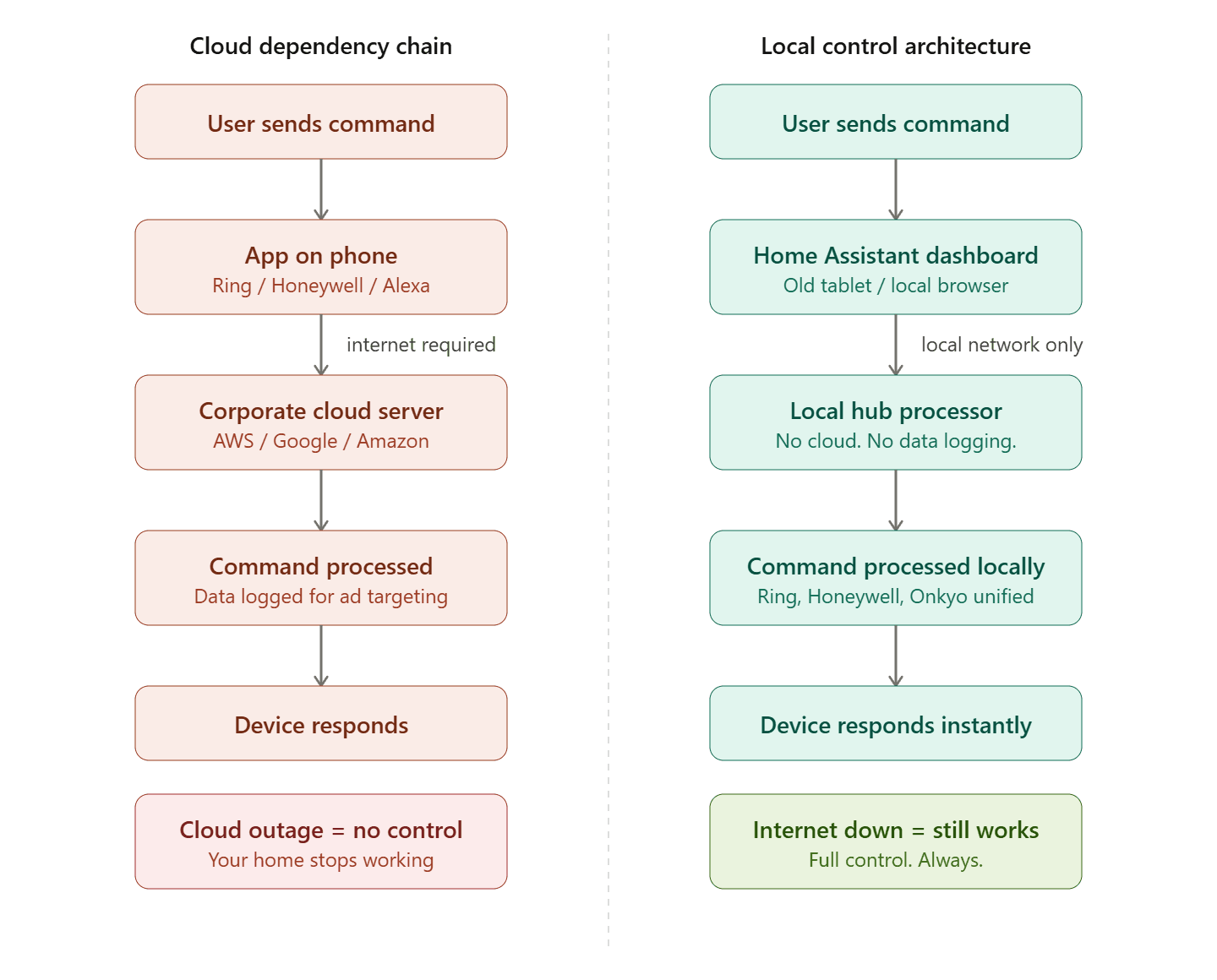
The solution to fragmented app ecosystems does not require new hardware purchases because most households already own the components necessary to build a fully functional local control environment. An older iPad or Galaxy tablet sitting unused in a drawer retains the display quality and wireless connectivity needed to serve as a high resolution dashboard for a local home automation hub. Legacy Onkyo receivers that predate smart home integration still deliver audio performance that rivals current generation hardware and respond to local network commands without requiring a cloud handshake to process a volume adjustment.
Home Assistant installed on a dedicated local processor transforms the fragmented ecosystem of Ring, Honeywell, and Onkyo hardware into a single unified dashboard operating entirely within the home network. After personally running Home Assistant for nearly a year however, the platform’s compatibility limitations become apparent quickly — the Honeywell Total Connect integration refused to establish a stable local connection, forcing continued reliance on the cloud app for thermostat control. That failure drove a direct switch to the Ecobee thermostat, which maintains native Home Assistant integration without the cloud dependency that makes Honeywell an unreliable partner in a local control environment.
The financial case for local control becomes compelling when the total cost of proprietary ecosystem ownership is calculated honestly across a three to five year ownership window. Eliminating Ring’s monitoring subscription, Honeywell’s remote access tier, and the incremental hardware replacement costs driven by planned obsolescence recovers an amount that frequently exceeds the one time cost of a local hub setup within the first eighteen months of operation. Readers ready to understand how legacy hardware eliminates the need for new purchases can explore the repurposing framework that covers the specific app and connectivity approach making older tablets fully functional as local dashboard displays.
Breaking Free From the Ecosystem Anchor
True home automation sovereignty requires a deliberate decision to treat local control infrastructure as a one time capital investment rather than an ongoing service relationship with a corporation whose business model depends on sustained consumer dependency. The hardware required to build a private local hub has become significantly more accessible over the past three years as open source platforms matured and dedicated local processors dropped below the cost of a single year of premium subscription fees across the major proprietary ecosystems. That cost crossover point represents the moment when the financial argument for local control became impossible for budget conscious consumers to ignore.
The practical outcome of breaking cloud dependency extends beyond subscription savings because it fundamentally changes the reliability profile of the entire home automation environment. A local hub running Home Assistant continues processing automation rules, responding to device commands, and maintaining security monitoring during complete internet outages because none of its core functions require external validation to operate. Readers ready to move beyond the ecosystem anchor and build a private smart home command center using hardware they already own can follow the complete local hub build guide covering the specific integration steps that unify Ring, Honeywell, and legacy audio hardware into a single dashboard that no corporate server can disable.