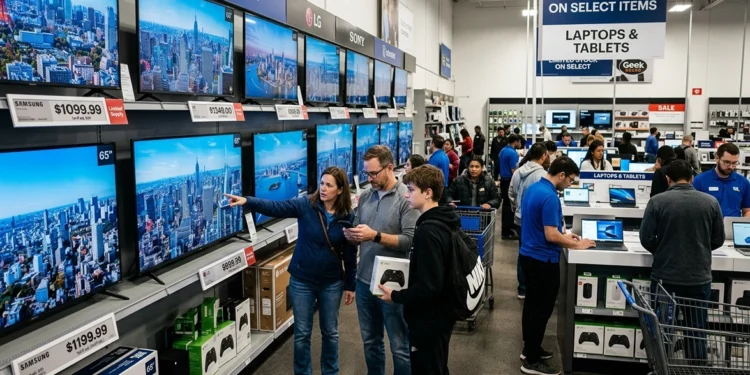
Last year’s holiday shopping season broke records. Consumers spent more than a quarter-trillion dollars online between November and December, and mobile devices carried the majority of that spending for the first time ever. These tech trends to watch show that this year’s market is shifting in ways few shoppers expect.
A handful of forces most shoppers have never heard of are now colliding at the same time, and they’re all converging on the same target: the price tag on your next gadget. Artificial intelligence infrastructure is quietly consuming the same memory chips that go into laptops and graphics cards. Tariffs are adding new costs to imported electronics that didn’t exist in the same form a year ago. Conflict overseas is rerouting cargo ships and stretching component lead times from weeks into months. None of these forces are new on their own, but stacked together, they’re reshaping what “normal” pricing looks like across nearly every category of tech.
Tech Trends to Watch This Season
Understanding tech trends to watch this season starts with recognizing that this isn’t a single-category problem. It’s not just graphics cards, and it’s not just laptops. Smart home devices, software subscriptions, gaming consoles, and everyday electronics are all touching the same strained supply chain in one way or another, which means the ripple effects show up in places shoppers won’t necessarily expect.
Demand data from last year already hinted at where this was heading. According to Adobe’s holiday shopping data, categories like home security products, smartwatches, and headphones and speakers all posted triple-digit growth compared to pre-season spending levels. That kind of demand surge, paired with a supply chain that’s tightening rather than loosening, tends to produce exactly the kind of price pressure that’s showing up now. When more people want the same limited pool of components, prices don’t stay flat.
The categories that grew fastest last year are largely the same categories now facing the steepest cost increases. That’s not a coincidence. Rising demand and shrinking supply rarely move in opposite directions for long, and the data from the past several months confirms that the gap between what people want and what manufacturers can affordably produce has only widened.
Why Upcoming Tech Trends Point to Higher Prices
Tariffs are one of the clearest, most measurable pieces of this puzzle. The Consumer Technology Association has estimated that tariffs on consumer tech imports could reduce U.S. purchasing power by roughly $123 billion, with retail prices climbing by more than 30 percent for smartphones and 34 percent for laptops and tablets. Those aren’t small adjustments. They represent a meaningful shift in what “normal” pricing looks like for products that used to feel predictable year over year.
A separate analysis found that tariffs could add close to $132 in extra holiday costs per shopper, with electronics carrying the single largest share of that burden at roughly $186 per person. According to Bloomberg’s tariff impact analysis, much of this exposure comes down to where these products are actually manufactured. Many TVs, smartphones, and tablets are built in China, India, and Vietnam, all of which have been directly affected by shifting U.S. trade policy, and that manufacturing concentration leaves very little room for companies to simply route around the added costs.
Consumers are also expected to absorb the majority of these costs themselves rather than manufacturers quietly eating the difference. Roughly 55 percent of tariff-driven cost increases are projected to land directly on the buyer, while businesses and foreign exporters split the remaining burden. That distribution matters, because it means shoppers shouldn’t expect retailers to fully cushion them from these increases through discounts or promotions the way they might have in past years.
Trending Tech Topics and the AI Factor
If tariffs are one half of this story, artificial intelligence is the other, and in some ways it’s the more disruptive one. Data centers and AI companies are now competing directly with everyday consumers for the same graphics cards and memory chips, which is a genuinely new dynamic that didn’t exist at this scale even two years ago. When a data center operator and a gamer are bidding on the same hardware pool, the gamer typically loses that fight on price.
The numbers make this tangible. Flagship graphics cards that launched with an official price near $2,000 have been selling for well over $3,500 on the open market, with some projections suggesting prices could climb even higher later this year. Behind that spike sits a memory shortage driven largely by AI infrastructure buildout, since the same GDDR6 and GDDR7 memory chips used in consumer graphics cards are also essential to the servers powering large-scale AI systems. When one side of that equation scales up demand dramatically, the other side feels the squeeze almost immediately.
This isn’t limited to top-tier enthusiast hardware, either. Mid-range and budget cards are absorbing indirect pressure too, since manufacturers are adjusting pricing across entire product lines rather than isolating increases to flagship models alone. Reports indicate both major GPU manufacturers implemented phased price increases in early this year rather than one dramatic jump, a strategy that makes each individual increase feel smaller while the cumulative effect on shoppers ends up being significant regardless.
Technology Trends to Watch While Building a Private AI Setup
One of the more interesting shifts happening alongside all of this is a rising number of everyday consumers building their own local AI setups, rather than relying entirely on cloud-based subscriptions. I went through this process myself recently, and it gave me a firsthand look at exactly how these pricing pressures play out in a real purchase decision. It wasn’t as simple as picking a graphics card off a shelf.
My first instinct was to go with a standard, more affordable graphics card, but that option only came with 8GB of video memory, which multiple 2026 benchmarks show becoming a real bottleneck for AI workloads specifically, not just gaming. In one image-generation benchmark test, the 8GB configuration performed nearly 98 percent worse than its 16GB counterpart, which is far too large a gap to responsibly ignore if the goal is actually running AI models rather than just gaming casually. That single data point changed my decision entirely.
I ended up going with a 16GB variant instead, since the extra memory headroom made the difference between a system that could genuinely handle local AI inference and one that would hit a wall almost immediately. But the graphics card wasn’t the only upgrade required. I also had to move to a Samsung 990-series solid-state drive to handle the faster read and write speeds AI workloads demand, since model files and datasets need to move in and out of storage quickly once video memory stops being the primary limiting factor.
For the actual software side, I run Ollama, an open-source tool recognizable by its llama-shaped logo, which makes it straightforward to download and run Llama-based AI models locally without depending on a cloud subscription or sending personal data outside your own machine. This entire build, graphics card, storage, and local software working together, reflects a distinct and growing category of buyer. People increasingly want AI capability they fully control, and that desire is now colliding directly with the same supply pressures already driving up hardware prices across the board.
What’s Trending in Tech as Laptops Face New Pressure
Laptops are facing a version of this same story, just with different specific numbers attached. Industry analysts have warned that laptop and desktop prices could climb by as much as 35 percent this year, driven primarily by soaring memory prices, processor shortages, and the same AI-driven demand squeezing the graphics card market. DRAM pricing alone jumped roughly 95 percent in the first quarter of this year, with additional increases still expected in the following months.
Memory now accounts for roughly 35 percent of a laptop’s total manufacturing cost, a sharp jump from the historical range of 16 to 20 percent just a few years ago. That shift matters because it removes flexibility manufacturers used to have when absorbing cost increases internally rather than passing them to consumers. According to Gartner’s chip shortage analysis, one senior analyst has gone as far as predicting that the sub-$500 entry-level laptop segment will disappear entirely within the next couple of years, since razor-thin margins on budget devices simply can’t survive this level of sustained cost pressure.
The consumer impact is already visible in real purchasing behavior, not just projected pricing models. Demand in the entry-level laptop segment has already fallen 20 to 30 percent as buying power weakens among price-sensitive shoppers, students among the hardest hit. Waiting for relief doesn’t appear to be a realistic short-term strategy either, since most forecasts suggest semiconductor pricing will remain unstable well into the coming months rather than correcting quickly.
Global Conflict and Tech Trends to Follow
Geopolitical instability adds yet another layer on top of tariffs and AI-driven demand, and it’s arguably the least visible of the three to everyday shoppers. Conflict in the Middle East has forced shipping companies to reroute cargo vessels entirely, which increases voyage times, fuel costs, and insurance premiums across the board. Maritime war-risk premiums have climbed to between 0.7 and 1 percent of total vessel hull values during peak disruption periods, a cost that inevitably works its way into the final retail price of imported electronics.
These disruptions extend beyond shipping logistics into the actual materials used in chip manufacturing. Supplies of semiconductor-grade helium have been affected by the broader conflict, and following strikes at industrial facilities in Qatar, lead times for certain components reportedly stretched from six weeks to as long as six months. A supply chain that already operates with very little slack doesn’t absorb that kind of disruption gracefully, and the resulting delays tend to compound rather than resolve quickly on their own.
Semiconductor manufacturing itself remains heavily concentrated in a small handful of global regions, which leaves very little room for companies to simply route around any single disruption. Export restrictions, shifting trade policy, and continued tension over chip-producing regions all add further uncertainty into a system that manufacturers already describe as fragile. Even domestic manufacturing investments currently underway won’t produce meaningful output for another year or more, meaning the industry will likely remain dependent on the same vulnerable international supply chains in the near term regardless of long-term plans.
Smart Buying and Tech Trends to Watch Before You Purchase
None of this means shoppers are entirely without options this season, but it does mean the old assumptions about timing a purchase no longer hold up the way they once did. Waiting for a traditional post-holiday price drop may not deliver the same relief this year, since much of this pressure is structural rather than seasonal, and structural cost increases tend to stick around longer than a typical sales cycle. Buyers who understand that distinction going in are far better positioned to make a genuinely informed decision.
Previous-generation hardware is emerging as one of the more practical paths forward for budget-conscious shoppers. Used graphics cards from the prior generation have actually become cheaper as early adopters upgrade to newer models, and mid-tier options continue to offer solid performance without the inflated premium currently attached to flagship releases. The same logic increasingly applies to laptops, where a well-reviewed previous-generation model can meaningfully outperform a brand-new entry-level device that’s been cost-cut to survive under current pricing pressure.
For anyone specifically drawn to the kind of local AI setup described earlier in this piece, prioritizing memory capacity over raw brand-name recognition tends to deliver the better long-term value. A graphics card with sufficient video memory will directly determine what you’re able to run locally, in a way that outweighs most other spec differences on paper. That single lesson, learned firsthand through trial and error, may end up being the most useful takeaway for anyone entering this market for the first time this season.
Staying informed on these shifting tech trends to watch ultimately comes down to recognizing that today’s pricing environment reflects several converging forces rather than any single, isolated cause. AI infrastructure demand, tariff policy, and geopolitical disruption are each significant on their own, and their combined effect is what’s actually reshaping the shelf price on everything from graphics cards to laptops to smart home devices this season. Shoppers who understand that bigger picture, rather than reacting to price tags in isolation, are the ones best equipped to make confident decisions heading into the months ahead.