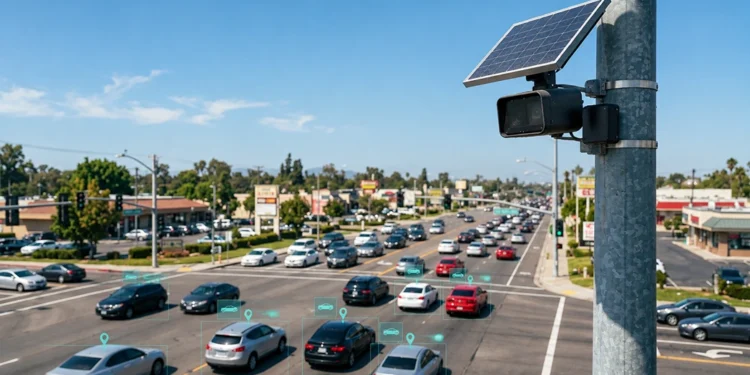
A Flock camera looks like a simple license plate reader bolted to a pole. That’s only part of the story, though. Flock camera privacy risk comes from everything else these devices are quietly built to do. Most drivers have no idea the list goes that far. The company’s own hardware now includes gunfire detection microphones and video surveillance capability alongside the plate-reading cameras most people recognize. What started as a modest tool for local police departments to find stolen vehicles has quietly grown into something bigger. It’s now closer to a nationwide surveillance infrastructure, built one small-town contract at a time.
That combination is exactly what drew a Senate Judiciary subcommittee’s attention this year. Lawmakers spent an afternoon asking hard questions about a nationwide network that now touches nearly every state. One senator’s opening line summed up the mood in the room. If you haven’t heard of Flock, Flock has probably heard of you. That line landed because it’s true for most Americans. Many have never even noticed a camera on their commute. That’s exactly why this deserves a closer look than the marketing materials provide.
What Flock Camera Privacy Risk Actually Involves
A Flock camera isn’t a traffic light camera, and it doesn’t issue tickets. It’s an automated license plate reader mounted at an intersection, highway on-ramp, or grocery store entrance. It photographs the rear of every vehicle that passes. The system logs the plate number alongside what the company calls a vehicle fingerprint. That includes make, model, color, and identifying details like bumper stickers or existing damage. None of that requires a warrant to capture. It’s all technically visible from a public road. That’s the legal argument the company leans on whenever the practice gets challenged. Courts have mostly accepted it so far. There’s no established expectation of privacy for what’s visible in plain sight, at least according to the current reading of the law.
The plate-reading feature is just the entry point. Many Flock installations also include Raven, a gunfire detection sensor. It listens continuously for the sound of gunshots across an entire neighborhood. Some markets have added Condor cameras with live video streaming. That gives police a real-time visual feed rather than just a single still photo. Each added feature expands what the network can see, hear, and record beyond a passing car. Each one also gets bundled into the same subscription contract a city council approves in a single vote. That vote often happens without a detailed public breakdown of which specific sensors are actually included in the package.
That expanding feature set is what turned this into a Senate hearing rather than a local news story. A system built to catch stolen cars and missing persons is how it’s typically pitched to city councils. That same system is also capable of building a rolling record of where nearly every driver has been. That’s exactly the kind of capability that draws Fourth Amendment scrutiny. It happens once people start asking who else gets to look at it. Once a network reaches this scale, the original narrow use case tends to shrink. It becomes one small feature among many rather than the whole story. The sales pitch rarely mentions that shift happening at all.
When the System Gets Someone Wrong
The clearest illustration of what can go wrong came from a Florida woman named Lindsey Isaacs. She testified at the hearing about her own arrest. A Flock camera photographed her car roughly three miles from a fatal crash scene. Investigators matched it based on make and model alone. Her vehicle was black. The car involved in the crash was maroon, according to a witness on scene. Nobody double-checked that detail before deciding it was close enough to justify an arrest warrant.
That mismatch didn’t stop her arrest. It’s a textbook example of Flock camera privacy risk playing out in a real person’s life. She spent three days in solitary confinement. Ten more followed in a maximum-security unit before prosecutors eventually dropped every charge against her. Her case became the hearing’s central example of what happens when an automated match gets treated as reliable evidence. It’s really just one data point that still needs real verification. Treating it as anything more can cost someone their freedom. A simple color mismatch like this one might have been caught by a human reviewer in seconds.
Cases like this are the reason several local officials have started pulling back rather than expanding their programs. The sheriff of Pinal County, Arizona testified that he ended his own department’s Flock contract after residents raised concerns. The company couldn’t adequately answer whether people could be identified in the images. That’s despite Flock’s own marketing insisting the resolution wasn’t sharp enough for that. When even law enforcement customers start walking away over transparency, that’s a signal worth taking seriously. It shouldn’t get dismissed as isolated activist pushback from people who don’t understand the technology.
Where the Data Travels After It’s Collected
The database itself doesn’t stay contained to whichever police department first ran the search. That’s where the concern extends well past any single wrongful arrest. Immigration and Customs Enforcement has accessed Flock data through local law enforcement partners. Those partners run immigration-related searches on the agency’s behalf, according to a 404 Media ICE report. That’s true even though Flock maintains it has no direct contract with the agency. The distinction between a direct contract and indirect access matters less to the person being tracked. It matters less than it does in a press statement, in other words. The search happens the same way either way, regardless of which name sits on the paperwork.
Misuse hasn’t been limited to federal agencies working around stated policy, either. A Washington Post investigation documented officers using the same camera network to track the movements of former partners. That turned a tool marketed for solving crimes into one used for personal surveillance instead. Once a system like this exists, restricting its use to the original purpose becomes mostly a matter of trust and internal policy. Both have already failed in documented cases. There’s little reason to assume those were the only instances. Most misuse only surfaces when the person being tracked happens to notice the pattern themselves and decides to speak up about it.
Why More Cities Are Reconsidering Their Contracts
This is the same tension we flagged in our earlier look at surveillance inside 15-minute cities. Infrastructure built for one civic purpose can quietly expand into something residents never explicitly approved. Several communities have already acted on that concern directly. Moline, Sterling, and Galva have all ended or paused their Flock contracts in recent months. Local officials cited public outcry and eroded trust in the vendor’s data-sharing assurances as the deciding factor. In more than one case, the decision followed a packed council meeting. That’s a very different outcome than a quiet policy memo circulated after hours.
That pattern is likely to keep repeating as more residents learn what’s actually running in their own town. A city council vote to approve a camera system rarely gets much attention. The moment someone discovers their own daily commute has been logged for months tends to get a lot more. That gap between quiet approval and loud discovery is exactly where most of these contracts eventually run into trouble. By that point, the equipment has usually already been installed and paid for in full.
How Flock Defends the Program
Flock’s standard response to these concerns leans heavily on audit logs and stated policy rather than hard technical limits. The company says every search a police department runs gets logged with a reason attached. Those logs, in theory, can be reviewed later if misuse is suspected. That creates a form of accountability after the fact. It does nothing, though, to prevent the search from happening in the first place. That’s the part critics keep coming back to during hearings like this one.
The trouble is that an audit log only helps if someone actually goes looking at it. Several of the misuse cases documented so far weren’t caught by Flock’s own logging system at all. They surfaced through investigative journalism, public records requests, or an officer’s ex-partner noticing a pattern on her own. That noticing is what led her to start asking questions in the first place. That gap between what’s logged and what actually gets reviewed is where accountability quietly breaks down in practice. It’s a gap that exists by design rather than by accident.
Company representatives have also pointed to contract language that restricts law enforcement customers to investigative use only. That language explicitly rules out personal surveillance or immigration enforcement without a documented criminal predicate attached to the search. It sounds reassuring on paper. In practice, it depends entirely on individual officers and agencies choosing to follow it without anyone actively checking. Given the cases already on record, that’s proven to be a thinner safeguard than the contract language suggests. It looks thinner still once you consider how few of those cases were ever caught proactively in the first place.
What You Can Actually Check in Your Own Town
Finding out whether your town already has a Flock contract usually starts with public city council meeting minutes. It doesn’t require any real investigative effort. Most municipalities are legally required to approve these contracts in open session. That vote typically shows up in searchable meeting archives or agenda packets on the city’s own website. If the meeting records aren’t clear, a public records request to the local police department will usually confirm whether a contract exists. It will also confirm which vendor supplies it, and the ACLU’s Flock toolkit offers a template for exactly that kind of request.
Some departments publish this information voluntarily now, listing active vendor contracts directly on their transparency pages without requiring a formal request at all. That’s partly in response to the same public pressure that’s driven several cities to cancel their contracts entirely, and it’s a trend more residents are starting to expect as standard practice rather than a rare courtesy. The broader lesson connects directly to what we’ve covered in how data moves unseen. A license plate database works on the same basic principle as any other data-sharing pipeline. Once your information enters a system, you rarely control who else eventually gets access to it. That’s true no matter how narrowly that system was originally described to the public.
None of this means every town with a Flock contract is doing something wrong. Plenty of departments genuinely do use the network the way it was pitched to residents, solving real cases without ever touching the gray areas that made national headlines this year. What it does mean is that the burden of oversight currently falls almost entirely on residents willing to ask questions. There’s no meaningful built-in check within the system itself that catches misuse before it happens. Staying informed about what’s actually approved in your own town remains the most realistic form of leverage any resident currently has against Flock camera privacy risk expanding further without a real conversation first.