Graphics card launches usually produce a predictable cycle of benchmark charts, pricing arguments, and comparisons that focus almost entirely on which GPU delivers the highest average frame rate. Those measurements are useful, but they rarely capture the complete ownership experience. Cooling performance, memory capacity, physical dimensions, software support, power requirements, display connectivity, and current retail pricing can be equally important when deciding whether a graphics card belongs in a gaming system.
The ASUS Prime Radeon RX 9070 XT 16GB OC enters that discussion as a performance-focused alternative to more expensive graphics cards. The card combines AMD’s RDNA 4 architecture with 16GB of GDDR6 memory, PCI Express 5.0 connectivity, and a factory overclock. Rather than pursuing the most elaborate design or highest possible clock speeds, the Prime model emphasizes high-resolution gaming, restrained styling, effective cooling, and compatibility with a wider range of systems.
Why the RX 9070 XT Is Getting More Attention
AMD designed the RX 9070 XT for high-refresh 1440p gaming and capable 4K performance. The underlying Navi 48 processor contains 4,096 stream processors, 64 ray accelerators, and second-generation AI acceleration hardware. The GPU also supports DirectX 12 Ultimate and current rendering features, making the RX 9070 XT significantly more advanced than earlier Radeon products that relied primarily on conventional rasterized performance. [techpowerup.com]
That more balanced architecture matters because current games increasingly mix traditional rendering, ray-traced effects, upscaling, and frame-generation technologies. AMD remains competitive in conventional rasterized gaming while RDNA 4 narrows some of the weaknesses associated with previous Radeon generations. Gamers Nexus found the RX 9070 XT and RTX 5070 Ti trading positions depending on the title, with several 4K rasterized tests placing the cards within approximately six percent of one another. RX 9070 XT performance against the RTX 5070 Ti provides useful context for understanding how heavily results depend on the game and rendering workload. [gamersnexus.net]
The card is not an automatic winner in every comparison. NVIDIA continues to hold meaningful advantages in some ray-traced games, CUDA-dependent applications, and parts of its broader software ecosystem. The reason gamers are reconsidering the RX 9070 XT is not that every previous disadvantage has disappeared. The attraction comes from receiving strong conventional gaming performance, 16GB of memory, improved ray tracing, and current display technology in a product that may cost less than its closest NVIDIA competitor.
The ASUS Prime Design Prioritizes Practicality
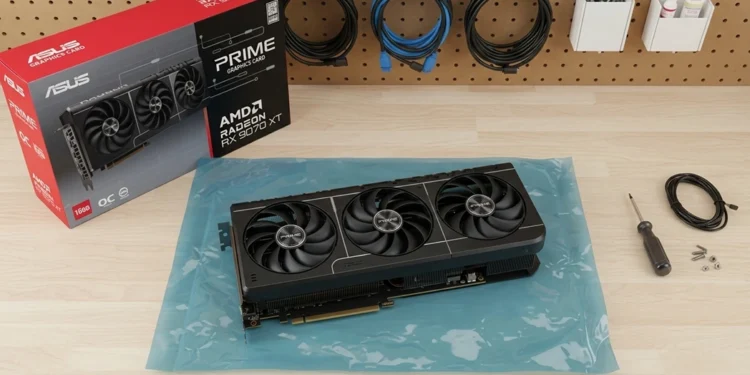
The ASUS Prime Radeon RX 9070 XT OC Edition uses a relatively understated exterior without the prominent lighting and aggressive styling found on many gaming-branded cards. ASUS equips the model with three Axial-tech fans, a vented backplate, dual-ball fan bearings, and a phase-change thermal pad. The 2.5-slot cooling assembly is intended to balance heat dissipation with compatibility instead of making the card unnecessarily thick. ASUS Prime RX 9070 XT cooling and design features explains how the fans, heatsink, backplate, and thermal interface work together. [asus.com]
ASUS lists dimensions of 312 by 130 by 50 millimeters, so the card still requires careful measurement before installation. It uses three eight-pin PCIe power connectors and carries a manufacturer recommendation for a 750-watt power supply. The display configuration includes three DisplayPort 2.1a connections and one HDMI 2.1b port, with support for as many as four displays. These details should be confirmed against the case, power supply, and intended display arrangement before purchasing. [asus.com]
The factory overclock is modest rather than extreme. ASUS specifies a default boost clock of up to 3010 MHz and game clock of up to 2460 MHz. Using OC Mode through GPU Tweak III raises those figures to 3030 MHz and 2480 MHz. This small increase maintains the product’s emphasis on stable operation rather than promising dramatic performance gains from clock speed alone. Actual operating frequency will still vary according to temperature, power availability, application behavior, and the capabilities of the individual GPU. [asus.com]
1440p Is the Card’s Strongest Use Case
The RX 9070 XT makes the most immediate sense for gamers using a 1440p high-refresh display. That resolution delivers a substantial increase in image detail over 1080p without placing the full rendering burden of native 4K on the graphics card. The available performance allows demanding games to use higher visual settings while maintaining the responsiveness expected from modern 120Hz, 144Hz, or faster displays.
Independent testing of the ASUS Prime model includes games such as Cyberpunk 2077, Black Myth: Wukong, Assassin’s Creed Mirage, F1 23, Far Cry 6, and Shadow of the Tomb Raider. Readers who want to see the exact card, its physical design, benchmark setup, thermals, and power behavior can watch the ASUS Prime Radeon RX 9070 XT OC video review. The video is directly relevant to this model and replaces the RX 6700 XT footage that no longer supports the updated article.
The 16GB memory configuration strengthens the card’s position at 1440p because modern titles can allocate substantial VRAM when high-resolution textures and detailed environments are enabled. Memory capacity does not guarantee performance by itself, but it gives the GPU room to handle larger assets without encountering restrictions associated with lower-capacity cards. The RX 9070 XT pairs its memory with a 256-bit interface and approximately 640GB/s of bandwidth, providing a balanced subsystem for the performance class. [techpowerup.com], [techspot.com]
Moving From Older Hardware Changes the Experience
Users moving from older or lower-tier graphics cards should experience more than an increase in average frame rate. The RX 9070 XT provides stronger high-resolution performance, modern display outputs, improved ray-tracing hardware, more advanced AI acceleration, and access to AMD’s current software features. These improvements allow a system to target higher settings while producing more stable performance in workloads that would overwhelm previous generations.
Our existing RTX 3060 performance analysis provides internal context for readers considering a substantial upgrade from an earlier mainstream GPU. The RTX 3060 is not a direct contemporary competitor to the RX 9070 XT, and the comparison should not be presented that way. It represents the type of older card many users may currently own, making the link relevant when discussing the scale and practical benefits of moving into a higher performance class.
An upgrade still cannot compensate for every system limitation. A weak processor, insufficient memory, restricted case airflow, or aging power supply can prevent a new graphics card from reaching its potential. Buyers should determine whether their current system can support the card electrically and physically while also delivering the CPU performance required for high-refresh gaming. That assessment helps prevent an expensive GPU purchase from exposing a different bottleneck immediately after installation.
Capable 4K Performance With Realistic Settings
The RX 9070 XT can deliver a credible 4K gaming experience, although results depend on the title, rendering method, image-quality settings, and ray-tracing workload. Reviews of the ASUS Prime model describe strong 4K performance and meaningful competition with the RTX 5070 Ti. Digital Citizen also found the card effective across high-resolution workloads while noting that NVIDIA retains an advantage in ray tracing. ASUS Prime RX 9070 XT 4K testing supports the card’s position as more than a 1440p-only product. [digitalcitizen.life]
A practical 4K configuration may require more adjustment than a 1440p setup. Ultra presets often enable expensive shadows, volumetric effects, reflections, and post-processing options that create modest visual improvements while consuming considerable performance. Beginning with a high preset and raising individual settings selectively usually produces a better balance than enabling every option automatically. This maintains image quality while protecting frame-time consistency during demanding scenes.
Upscaling can provide additional performance when native 4K becomes too demanding. The effectiveness of FSR varies by game, implementation, and selected quality level, so the feature should be evaluated during gameplay rather than judged from a static menu. Quality-oriented modes generally provide the most reasonable starting point because they reduce rendering workload without immediately accepting the larger visual compromises associated with aggressive performance settings.
RDNA 4 and Radeon Software Matter
AMD’s hardware is only one part of the product. Radeon Software: Adrenalin Edition provides access to driver updates, performance monitoring, per-game profiles, tuning controls, Radeon Anti-Lag, Radeon Boost, Radeon Chill, Radeon Super Resolution, Fluid Motion Frames, FreeSync, Smart Access Memory, and HYPR-RX profiles. Not every feature benefits every game, but the software creates several ways to adjust responsiveness, visual quality, power behavior, and displayed smoothness. [amd.com]
The best approach is to establish a stable baseline before enabling multiple enhancements. Owners should begin with a current driver, confirm normal temperatures and clock behavior, and test several familiar game sequences. One feature can then be enabled at a time so any improvement or regression remains identifiable. Applying every available option simultaneously makes troubleshooting difficult and may create combinations that do not benefit the selected title.
A broader guide explaining frame generation, Smart Access Memory, Radeon Anti-Lag, windowed-game optimization, and undervolting is available through settings and features that can maximize GPU performance. The article is not a benchmark source for the RX 9070 XT, but it supports the principle that software configuration and system settings can influence how effectively a graphics card performs.
Cooling Behavior Supports Sustained Gaming
Cooling quality matters because advertised boost clocks mean little if a card cannot sustain performance during an extended gaming session. ASUS states that the Prime model stops all three fans when GPU temperature remains below 55 degrees Celsius and restarts them after temperature exceeds 60 degrees. The heatsink, phase-change thermal pad, vented backplate, and Axial-tech fans are intended to manage sustained loads while limiting unnecessary fan noise during lighter activity. [asus.com]
Independent reviews describe the cooling system as effective, with quiet operation and well-managed temperatures. The card also includes a dual-BIOS switch, allowing users to select between available operating profiles without relying exclusively on software. These features are useful for owners who prioritize acoustics or want a straightforward fallback when experimenting with fan behavior and tuning. [digitalcitizen.life], [pokde.net]
Undervolting may further reduce temperature and power consumption, but tuning should remain optional rather than necessary for normal operation. A sensible process begins by recording default performance, hotspot temperature, average clock speed, fan speed, and power draw. Voltage can then be reduced gradually while testing games and repeatable workloads. Instability, visual artifacts, driver resets, or crashes indicate that the adjustment has moved beyond the individual card’s reliable operating range.
RX 9070 XT Versus RTX 5070 Ti
The RTX 5070 Ti is the RX 9070 XT’s most relevant competing reference. Both cards offer 16GB of memory and target high-refresh 1440p gaming with capable 4K performance. NVIDIA uses faster GDDR7 memory and retains important advantages in ray tracing, DLSS support, CUDA acceleration, and several creator workloads. AMD counters with competitive rasterized gaming and a pricing position that can create better performance per dollar when the retail gap is substantial. [thepcenthusiast.com], [graphicscardhub.com]
Gamers Nexus found that the cards traded positions across tested games, with rasterized 4K results frequently remaining close. Ray tracing produced more variable outcomes, including workloads where NVIDIA maintained a significant advantage and others where RDNA 4 proved more competitive. This evidence supports comparing individual games rather than using one generalized performance claim. A buyer whose library emphasizes conventional rendering may reach a different decision from someone prioritizing heavy ray tracing. [gamersnexus.net]
Retail price ultimately determines whether the RX 9070 XT achieves its value advantage. Launch pricing is useful historical information, but it does not establish what either product costs when a reader is ready to purchase. Buyers should compare current prices for models with similar cooler quality and warranty coverage. A small price difference may justify selecting the faster or more feature-complete card, while a larger gap can make the Radeon substantially more attractive.
Content Creation and AI Need Application-Level Research
The RX 9070 XT includes 128 matrix cores and dedicated AI acceleration resources, while its 16GB memory capacity can assist workloads involving large assets or locally processed models. Those specifications make the card relevant to mixed-use systems that handle gaming, video work, graphics creation, and AI experimentation. However, hardware capability cannot guarantee equal performance in every application because software support and vendor-specific acceleration differ considerably. [techpowerup.com]
Creators should verify the exact applications, encoders, plug-ins, rendering engines, and AI frameworks they intend to use before purchasing. Some tools support AMD hardware effectively, while others rely heavily on CUDA or features optimized for NVIDIA GPUs. The RX 9070 XT is therefore easiest to recommend as a gaming-first product with additional compute flexibility, not as a universal replacement for every specialized professional workstation configuration.
BuyersBeat Verdict
The ASUS Prime Radeon RX 9070 XT 16GB OC succeeds by combining strong gaming performance with a restrained, practical board design. Its 16GB memory capacity, improved ray tracing, current display connectivity, triple-fan cooler, dual BIOS, and conventional eight-pin power connections create a well-rounded package for high-refresh 1440p gaming and carefully configured 4K play. The card still requires adequate case clearance and a suitable power supply, so compatibility checks remain essential.
The RTX 5070 Ti remains compelling for gamers who prioritize ray tracing, DLSS, CUDA applications, or NVIDIA’s wider software ecosystem. The RX 9070 XT becomes more persuasive when conventional gaming performance, memory capacity, and purchase price carry greater weight. Neither product wins every category, which is why current pricing and the buyer’s actual game library should determine the final choice rather than generalized brand loyalty.
For gamers upgrading from cards such as the RTX 3060 or older Radeon hardware, the ASUS Prime RX 9070 XT represents a meaningful shift in resolution targets, visual settings, and modern rendering support. The upgrade is not simply about producing more frames. It creates additional room for higher-quality textures, more demanding games, faster displays, and software features that can extend the useful life of the system.
That combination explains why gamers are taking a second look. The ASUS Prime RX 9070 XT does not need to dominate every benchmark or professional workload to become the right GPU for a particular build. It needs to provide consistent performance at the user’s preferred resolution, maintain acceptable thermals and acoustics, and offer enough value to justify choosing it over competing products. For gaming-focused buyers who find the card at a competitive price, it delivers a convincing balance of performance, cooling, memory, and long-term usability.
Graphic Cards
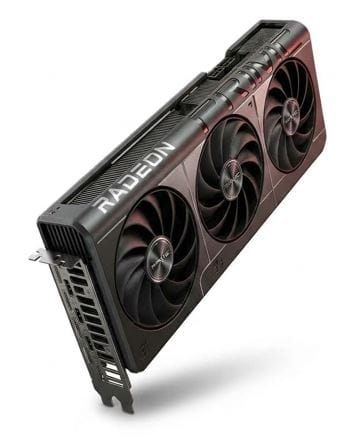
ASUS Prime Radeon
RX 9070 XT 16GB OC
A high-performance graphics card built for smooth 1440 gaming, capable 4K performance, and demanding creator workloads without high-end level pricing.