Beats Solo 4 headphones make a simple promise. They offer up to 50 hours of playback from an on ear pair that skips noise canceling. That trade will suit some listeners and frustrate others. Reviewers agree on the battery and the isolation. They split on comfort and sound, so a careful look at the details helps before anyone spends money.
This guide covers battery life, fast charging, passive isolation, fit, sound, controls, and platform features. It relies on published reviews and launch coverage. Each section notes where testers disagreed, because a pair of headphones rarely feels the same on every head. Prices change often and stay out of the discussion, which keeps the advice useful long after a sale ends.
The central question is whether a long battery and a light frame outweigh the lack of active noise canceling. Some listeners will answer yes without hesitation, especially those who dislike charging cables. Others will want the quiet that noise canceling provides, so the later sections help sort buyers into the right group. Several sections also include practical tests that make the choice easier to check at home.
[IMAGE 1: black and gold Beats Solo 4 headphones product photo (hero)]
Beats Solo 4 Headphones at a Glance
Beats Solo 4 headphones are wireless on ear headphones with a folding design. According to T3’s review, they weigh 217 grams. The John Lewis testing lists the same weight and calls it very light. Light weight matters for headphones that sit directly on the ears all day. T3 adds that the memory foam cushions are angled and covered in a plush material. Together, those details explain why Beats Solo 4 headphones earn praise for comfort from some reviewers.
The pair charges over USB-C. T3 notes that the Solo 4 is the first in the line to play audio over USB-C, which allows listening while charging. A 3.5 millimeter cable also works when the battery is empty, according to Pocket-lint launch coverage. Those two options make a dead battery far less of a problem.
Bluetooth 5.3 handles the wireless connection, per T3. The headphones run on a Beats platform instead of the Apple W1 chip used in the Solo 3. T3 describes them as operating system agnostic, so they work with both iOS and Android. Some extra features remain Apple only, and later sections cover those differences in detail.
Fifty Hours of Battery in Daily Use
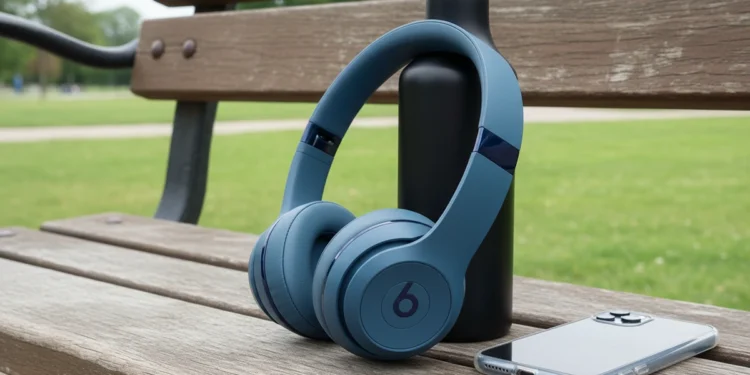
[IMAGE 2: slate blue Beats Solo 4 headphones leaning on a black water bottle on a wooden park bench]
The maker rates Beats Solo 4 headphones at up to 50 hours of battery life. TechRadar’s review reports that the claim appeared to hold true in testing. The charge dropped about five percent per two and a half hours without Spatial Audio. John Lewis says that figure covers a couple of weeks of daily commutes and gym sessions. Actual results will vary with use, so the numbers work best as a guide for planning. Even so, a battery that lasts this long changes how often anyone has to think about charging.
That endurance anchors the whole trade. A simple way to estimate runtime is to divide 50 by the hours played each day. A listener who plays music for about seven hours a day gets roughly a week from one charge. Lighter users stretch the same battery across several weeks. Fewer charging sessions also mean fewer moments when a dead battery interrupts a trip. That is the main benefit that justifies skipping noise canceling. Because the TechRadar figure excludes Spatial Audio, anyone who plans to use that feature should expect a shorter window. Students, commuters, and frequent travelers may value this freedom most, since their days leave little time for charging.
Fast Fuel Charging for Short Gaps
Fast Fuel handles the moments when the battery on Beats Solo 4 headphones runs low. Pocket-lint reports that a 10 minute charge gives up to five hours of playback. T3 and John Lewis repeat that figure in their reviews. For example, a short top up while packing a bag can cover a long commute or a full afternoon of work. That speed turns a flat battery from a ruined plan into a minor delay. Fast Fuel also removes the pressure to charge overnight. A few minutes at a desk is enough to keep Beats Solo 4 headphones ready for the rest of the day.
Charging happens over USB-C, so the same cable that serves a phone or laptop can also serve the headphones. In addition, Pocket-lint notes that USB-C carries lossless audio from a supported device. A single cable in a bag therefore covers charging, listening while charging, and a wired connection when needed. Travelers benefit most, since fewer cables mean less to pack and less to lose. Even so, the 3.5 millimeter cable remains the simplest backup when no outlet is nearby. Keeping that cable in a bag costs almost nothing and protects against the worst case.
Living Without Noise Canceling
The Beats Solo 4 headphones have no active noise canceling, and every source checked for this guide says so plainly. TechRadar lists it among the drawbacks. T3 says its reviewer initially worried about the missing feature but would not miss it at all. That split shows how personal the decision is.
Passive isolation does much of the work instead on Beats Solo 4 headphones. TechRadar rates the isolation as excellent. John Lewis describes a really tight passive seal that blocks a lot of outside noise. T3 ties the strong grip to that isolation as well. The result is a pair that quiets a crowded commute without any electronics doing the work. That approach also keeps the design simple.
TechRadar also notes that the Sony ULT Wear WH-ULT900N offers better sound, comfort, and noise canceling at a similar price. That comparison is worth weighing for anyone who needs quiet above all. Buyers who value the battery and the light design more than silence may still prefer the Solo 4. Others will see the missing feature as a dealbreaker, and that reaction is perfectly reasonable. Anyone who wants strong noise canceling can compare the Sony noise canceling headphones or the Bose QuietComfort Ultra headphones before deciding. The choice comes down to priorities. Picture the loudest place the headphones will visit, then decide whether passive isolation feels like enough. Beats Solo 4 headphones ask the listener to accept some outside noise in exchange for simplicity, long battery life, and a light frame.
Comfort and Clamp on Beats Solo 4 Headphones
Comfort is where the reviews disagree most. TechRadar describes the grip as impressively solid for on ear headphones and says the pair stayed on during exercise. The same reviewer could not wear them for more than an hour at a time. That reviewer also criticizes the thin headband padding. T3 calls them excellent for exercise, and John Lewis says they stay put during workouts.
John Lewis says the cushions feel incredibly soft. Even so, the clamping pressure builds over hours of desk use, so breaks are needed. T3 lists substantial clamp force as a drawback and says the pressure can feel uncomfortable and hot over time, especially with glasses. Those details matter more for Beats Solo 4 headphones than for over ear designs, because on ear pads sit directly on the ears.
The practical advice is to match the headphones to the wearing pattern. Short sessions, commutes, and workouts suit the firm grip. All day desk work may call for a pair with lighter pressure. Trying them on for a full hour before the return window closes is the most reliable test, since head shape changes the result. People who wear glasses should test with their glasses on, since T3 flags that combination. Anyone who finds the grip too firm can still decide whether a short break every hour makes the pair workable. That kind of honest test matters more than any review score, because comfort is the one feature that cannot be measured on a spec sheet.
Sound Quality and Reviewer Disagreements
Sound ratings for Beats Solo 4 headphones vary widely. John Lewis calls the sound beautifully balanced, punchy, and crisp. T3 describes it as powerful and balanced, with strong, layered bass and treble that lacked nothing. TechRadar is less impressed, finding the bass inconsistent at times, the lower mids muddy, and the highs short on sparkle. Reviewers who listen to different music on different heads will reach different conclusions, and that is normal. For that reason, no single verdict should settle the question for every buyer.
T3 and Pocket-lint report that the headphones are passively tuned. The sound therefore stays the same over Bluetooth, USB-C, or the 3.5 millimeter cable. T3 also notes there is no equalizer, so the tuning is fixed. TechRadar found that lossless playback over USB-C was not radically different from Bluetooth. Buyers should treat wired and lossless options as conveniences and not as sound upgrades. A good test is to play familiar tracks with strong bass and clear vocals, then decide whether the balance feels right. Pay attention to whether the bass stays tidy, since TechRadar found it inconsistent. Because there is no equalizer to adjust, the first impression is likely to last.
Controls, Calls, and the Carry Case
TechRadar found the controls frustrating. The main button is easy to press by accident, and the volume buttons are hard to find. The power button is also hard to locate by feel, and holding it too long enters pairing mode. T3 lists the lack of wear detection among the drawbacks and notes that the battery indicator lights from older models are gone. The microphone is clear and loud, though TechRadar notes that it picks up background street chatter.
Beats Solo 4 headphones fold for travel, and they come with a case. John Lewis describes a woven carrying case. TechRadar calls it a soft fabric case that offers less protection than a hard shell. The small opening is awkward to use. Reviewers also differ on build. TechRadar finds the plastic less than premium, with loose hinges and earcups that do not swivel. T3 says the headphones feel premium in hand and resist fingerprints. Anyone who carries the pair in a crowded bag may want to add a harder case. Beats Solo 4 headphones also reward a few minutes of practice with the buttons, because the layout takes time to learn. Testing the controls during the return window is the best way to find out whether the layout suits daily use.
How Beats Solo 4 Headphones Work With Apple and Android
Beats Solo 4 headphones work with both major platforms, and the retail listing describes them as Apple and Android compatible. T3 calls them operating system agnostic. That openness is a real change from the Solo 3, which relied on an Apple chip. Android owners no longer need to avoid the line. Even so, Apple owners get a few extras, and Android owners should know exactly which ones are missing.
Some features stay tied to Apple devices. TechRadar reports that Personalized Spatial Audio with head tracking is Apple only, along with Hey Siri and Audio Sharing. T3 says head tracking uses a gyroscope and an accelerometer in the headphones and works with Dolby Atmos on Apple devices. TechRadar adds that head tracking works well and that the passive isolation improves the effect.
Fast pairing and auto switching work within each ecosystem, according to TechRadar. The same review lists missing multipoint pairing and missing aptX and LDAC support as drawbacks. The headphones therefore connect to one device at a time. Android buyers who want high resolution Bluetooth codecs will look elsewhere. Platform fit should be part of the decision. Apple owners who prefer earbuds can read our AirPods 5 earbuds guide for a different approach. Write down which of these features matter before buying, then check each one against the lists above. Someone who never uses head tracking or voice assistants loses almost nothing on either platform.
Who Should Buy Beats Solo 4 Headphones
The strengths are clear. Beats Solo 4 headphones offer up to 50 hours of battery life, fast charging, and strong passive isolation. They also have a light 217 gram frame and a grip that stays put during workouts. John Lewis rates them four out of five stars and calls them worth investing in for the gym, commuting, and daily use. T3 calls them a premium choice for versatile listening.
The drawbacks are just as clear. TechRadar says the pair is less impressive than rivals at the same price. It cites no noise canceling, no multipoint pairing, discomfort during long sessions, and earcups that do not swivel. Listeners who want a lighter touch on the head, strong noise canceling, or flexible codecs should compare other pairs first. Buyers who value battery above everything else will weigh these points differently. In the end, Beats Solo 4 headphones fit a clear type of listener. That person wants a light, durable pair that rarely needs charging.
Value deserves a clear look. Premium hardware costs more up front. The rising cost of consumer devices shows up in many categories, as our coverage of tariffs on hardware explains. Weigh that cost against how many hours the headphones will be worn each week. For listeners who put battery first, Beats Solo 4 headphones deserve a serious look.
Audio Gear (Headphones)
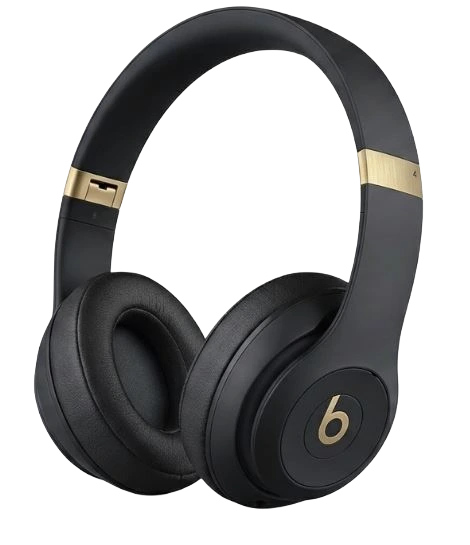
Beats Solo 4
Wireless Noise On-Ear Headphones