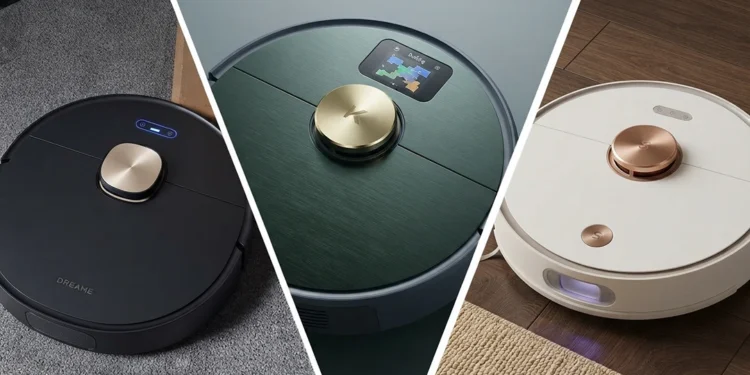
For most of the past decade, robot vacuum innovations meant accepting a long list of quiet compromises. You’d get a machine that mapped your floor plan beautifully on paper but still managed to strangle itself on a phone charger, smear a wet mop pad across clean tile, or simply give up the moment it hit a door track higher than half an inch. The category promised hands-off cleaning and mostly delivered hands-off frustration instead.
That’s finally starting to change, and not because of another marginal suction bump or a flashier app. The real shift has come from manufacturers finally engineering around the specific, physical failures that made these machines a hassle to own in the first place, rather than layering another software feature on top of hardware that couldn’t actually clear a door track. Climbing mechanisms, detangling brush systems, and smarter obstacle detection have moved from marketing bullet points to features that actually hold up in a real home, which is a meaningfully different bar than passing a demo on a spotless showroom floor.
Why Threshold Climbing Finally Works
For years, a raised door track or a thick area rug edge was often enough to strand an otherwise capable robot vacuum entirely. Most designs relied on small wheels and minimal ground clearance, which meant anything taller than a coin could turn into an impassable wall. That single limitation forced owners to either remove transition strips altogether or babysit the machine room by room, which defeated the entire point of buying one.
Retractable leg mechanisms have quietly solved this problem in a way that felt almost impossible a few years ago. The L50 Ultra’s climbing legs lift the chassis high enough to step over vertical thresholds that would have trapped nearly every previous generation of hardware, letting it move between hardwood, tile, and rugs without triggering an error notification. Other manufacturers have followed with their own versions of the same idea, recognizing that navigation intelligence means very little if the hardware physically can’t get where it needs to go.
Independent testing backs up just how significant this shift has been across the category as a whole. According to Vacuum Wars rankings, robot vacuum innovations now use retractable leg systems capable of clearing obstacles up to roughly three inches tall, a threshold that would have been considered science fiction for this category only a couple of generations ago. That kind of clearance turns a machine from a fragile sensor array into something that can genuinely handle a normal home’s layout without constant supervision, and it explains why climbing ability has quickly become one of the first specs serious buyers check before anything else.
How Robot Vacuum Innovations Finally Beat Tangled Hair
Long hair wrapped around a spinning brush roll used to be the single most reliable reason a robot vacuum ended up back in its box within a month of purchase. Weekly brush maintenance became an unavoidable chore, especially in homes with pets or anyone with hair past shoulder length, and the frustration of that recurring task did more to sour buyers on the category than any navigation complaint ever did.
Dual-brush and channel-guided systems have largely closed that gap, and the difference shows up clearly in controlled testing rather than just marketing copy. The V50 Ultra’s anti-tangle brush uses robot vacuum innovations, directing hair away from the axle instead of letting it wind around a single spinning roller the way older designs did. That mechanical change alone accounts for most of the maintenance complaints that used to define ownership of these machines.
The improvement isn’t isolated to one brand chasing a single headline feature, either. Consumer Reports’ pet-hair tests found that current-generation anti-tangle brush systems now prevent hair entanglement almost entirely during standardized testing, a dramatic shift from the near-universal tangling problems these categories faced only a few years earlier. When a feature moves from marketing claim to measurable lab result, it stops being a gimmick and starts being a real reason to trust the hardware.
Obstacle Avoidance Has Grown Up Too
Getting stuck on a threshold or tangled in hair used to overshadow a third, equally common failure: robot vacuums running straight into charging cables, pet bowls, and shoes left in the middle of a hallway. Early obstacle avoidance systems relied on simple bump sensors that only reacted after a collision already happened, and structured light and multi-sensor systems have since changed that reactive approach into something closer to genuine spatial awareness, combining cameras, depth sensors, and AI-driven object recognition to identify hazards before ever making contact with them.
Independent testing shows just how far this specific piece of tech has come in a short span of time. A recent roundup of obstacle avoidance roundup found flagship hardware now successfully dodging nearly every object placed in a standardized obstacle course, a dramatic improvement over the coin-flip reliability that defined this feature only a few product cycles ago. When a robot vacuum can reliably tell the difference between a sock and a stair edge, the whole category starts feeling less like a novelty and more like an appliance you can actually trust unsupervised around pets or young kids.
Where Everyday Ownership Still Falls Short
Not every long-standing complaint about this category has been fully resolved, and it’s worth being honest about where the gap still shows up. Budget and mid-range models still lag noticeably behind flagship hardware, meaning shoppers on a tighter budget are more likely to run into the exact climbing and tangling problems that flagship models have mostly solved, even if the box uses similar-sounding marketing language.
Our own breakdown of obstacle avoidance roundup covers this trade-off directly, since the investment still depends heavily on layout and budget rather than just brand reputation. A single-level open floor plan with hardwood throughout has very different needs than a multi-level home filled with transition strips, rugs, and pet hair, and no amount of marketing language changes that underlying reality. Buyers who match the hardware to their actual home layout tend to end up far more satisfied than those chasing the highest suction number printed on the box.
Choosing the Right Model for Your Home
None of this means every robot vacuum on the market has suddenly become worth buying, and price still tracks closely with which specific problems a given model has actually solved. Flagship-tier hardware carrying genuine leg-climbing systems, dual anti-tangle brushes, and multi-sensor obstacle avoidance tends to sit well above budget pricing, and that gap increasingly reflects real engineering differences rather than pure brand markup dressed up in a longer spec sheet.
A machine like the Dreame L50 Ultra makes the most sense for homes with tricky thresholds and mixed flooring, where climbing ability solves an actual daily frustration rather than sitting unused as a spec sheet bullet point. Homes with simpler, single-level layouts and fewer transition points may find that a model like the Mova V50 Ultra delivers most of the same tangle-free convenience without paying a premium for climbing hardware that would rarely get used in that specific setup.
Reading past the suction number on the box remains the single most useful habit for anyone shopping in this category today. Checking specifically for threshold clearance height, brush design, and independent obstacle avoidance results rather than relying on manufacturer claims alone will tell you far more about how a machine will actually perform in your own home than any single marketing bullet point ever could.